Pages

Friday, April 22, 2016

S is for Sadhana

 
 As always, a huge shout out to Ninja Minion Master Captain Alex and his army of ninja minions! 


My Theme: Yoga.  For those of you who don't know, I've been working on obtaining my yoga teacher's certification for the past year and am just a little over a month from graduating with my RYT200.  As such, I figure there's no better way to spend this month than teaching you folks some of what I've learned.
 
Sadhana means "inner alter" and is used to describe one's personal spiritual process.  For practitioners it usually involves some asana (usually ones that nourish a deficient chakra), meditation, artistic expression and some kind-of ritual designed to enhance one's relationships with a higher power.
 
For personal reasons, it exist to nourish one in the way they need to be nourished.  For ethical reasons, it exists to keep a yoga teacher's classes focused on the needs of the students (because that teacher is meeting their own needs within their sadhana).
 
 For me, my sadhana consists of meditating, chanting Om seven times to align each of my seven chakras, and trying to be open to what the universe has to offer me on a given day.  I do it every morning before I start my day with the hopes that it will allow me to be mindful, focused and aligned.  
 

Thursday, April 21, 2016

R is for Raga

 
 As always, a huge shout out to Ninja Minion Master Captain Alex and his army of ninja minions! 


My Theme: Yoga.  For those of you who don't know, I've been working on obtaining my yoga teacher's certification for the past year and am just a little over a month from graduating with my RYT200.  As such, I figure there's no better way to spend this month than teaching you folks some of what I've learned.
 
Raga is the condition of wanting and one of the four types of avidya that cloud one's perception and prevent them from seeing things as they truly are.  Raga creates suffering because it keeps one perpetually craving something other than reality.
 
In the classic sense, raga only leads to more raga because when we get what we want we just go ahead and start wanting something else.  It's a cyclical pattern, a snake eating it's own tail, and it is one of the root causes of all human suffering.
 Image result for wanting quotes
In the Buddhist philosophy it is the primary cause of all human suffering.  Yoga sees a few other forms of avidya that contribute (including fear, avoidance and ego)- but either way it's important to understand how it impacts one's life.
 
Raga isn't just about wanting what we don't have, it's about not wanting what we do have.  And it is usually brought on by comparison and described in "should"s.  For example "I should make more money" (the classic desire issue), "I shouldn't be freaking out over this" (the comparison issue, in this case based on the assumption that someone else in this situation would be handling it differently) and "I shouldn't have to deal with this" (the flat-out denial issue).
 
Every form of wanting creates suffering because every single form argues with reality, with what is.  This is where that quote comes in: it is what it is.  It's a reminder to not let ourselves get sucked into this trap.  And, if you want to get spiritual about it, it's reminder that we already have everything we need.  Freedom (the opposite of suffering) come abut when we stop arguing wit reality and accept what is.  Because once we accept, then we gain the capacity to change it.  And yoga, needless to say, helps us do both of these.
Image result for katie byron quotes 

Wednesday, April 20, 2016

Q is for Quiet

 
 As always, a huge shout out to Ninja Minion Master Captain Alex and his army of ninja minions! 


My Theme: Yoga.  For those of you who don't know, I've been working on obtaining my yoga teacher's certification for the past year and am just a little over a month from graduating with my RYT200.  As such, I figure there's no better way to spend this month than teaching you folks some of what I've learned.
 
One of the main purposes of yoga and meditation practices is to quiet the mind, a process described in many of the texts i've read as "yoking".   Traditionally, yoking refers to the process of fitting an animal or two with a device used to attach a harness to them for the purpose of plowing, pulling or otherwise utilizing the power of the strong animal to do work.  They use this word in reference to the mind because the same idea applies: the brain is incredibly powerful thing and we must harness its power in order to direct it energy towards a particular goal.
 
 Here's the problem: most of us have no earthly idea how to do that.  Usually our thoughts run free, unchecked, like the proverbial bull in a china shop (or ox if you're staying with the yoking metaphor) and we get stuck i patterns of thought that do not serve us.  It's a condition we often refer to as "crazy monkey mind" because it feels like our thoughts skip from one thing to the next much like a money swinging from branch to branch- uncontrolled, scattered, and destructive.
 
Yoga, mindfulness, meditation and all the other techniques we practice within this realm are all designed with the same end: quieting that crazy monkey mind of ours.  The techniques are varied but all have within them an element of distraction: giving the money something to do while you, the observer of the mind, do more important things.  This is why we meditate- focusing on breath gives the mind something to do.  This is is why we do asana (same goal).  This is why we chant, create mandalas, hold mudras with our hands, etc.  Yes, there's a ritual element to them, there are other things going on but the primary purpose is the same:  "Here, brain- go do this.  And I'll be over here, gaining a greater level of insight by watching you work."
 
Quiet is the space underneath the conscious activity where we finally have the ability to observe.  And what we're observing here, from a non-mind space, is reality.  We're seeking something called "clear sight" or "vidya" (see V) and it's why we do what we do.

Tuesday, April 19, 2016

P is for pranayama

 
 As always, a huge shout out to Ninja Minion Master Captain Alex and his army of ninja minions! 


My Theme: Yoga.  For those of you who don't know, I've been working on obtaining my yoga teacher's certification for the past year and am just a little over a month from graduating with my RYT200.  As such, I figure there's no better way to spend this month than teaching you folks some of what I've learned.
 
Pranayama means breath control or, alternately, breath liberation and describes the process of deep breathing one engages in while meditating.  In my teacher training we learned about 4 different kinds of basic breath that the human body engages in.  (This doesn't include the various types of breathing practices one learns in yoga like fire breath.)
 
In paradoxical breath, there is a sharp inhalation and the diaphragm moves up within the abdominal cavity (like a gasp).  In constricted thoracic breathing the volume of breath is low, the abdominal muscles are rigid, the diaphragm moves upward and the body is in a state of stress.  Both of these forms of breath are extremely unhealthy as it decreases the amount of oxygen in the bloodstream and constricts the muscles.
 
In thoraco-diaphramatic breath the diaphragm moves down and the rib cage expands up and out- this expands the entire thoracic cavity and allows the lungs to fully inflate.  In abdominal breathing the diaphragm moves down into into the abdominal cavity in the lower torso, forcing the belly to expand outwards (thus why it's referred to as belly breathing.  Both of these types of breathing are very healthy due to the increased amount of oxygen in the bloodstream and improved muscle control.  
 
In yoga we regularly practice a combination of the last two wherein we attempt to fully expand both the thoracic and abdominal cavities so that not only does the belly expand but the rib cage also moves up and out.  Breathing in this way is a difficult endeavor when first practiced as we are not used to using our muscles in such a way.  However, with regular practice individual gain control and learn to harness the breath.
 
The single most interesting thing about breathing, in my opinion, is the way that the air moves.  Most people believe (incorrectly) that the body is sucking the air in, like a vacuum.  In actuality, expanding the cavities in the torso decreases the air pressure inside the body such that the air pressure outside become great enough to force the air in.  So it's not really your body breathing in, it's opening up the space for the universe to force its way in. 

Monday, April 18, 2016

O is for Om

 
 As always, a huge shout out to Ninja Minion Master Captain Alex and his army of ninja minions! 


My Theme: Yoga.  For those of you who don't know, I've been working on obtaining my yoga teacher's certification for the past year and am just a little over a month from graduating with my RYT200.  As such, I figure there's no better way to spend this month than teaching you folks some of what I've learned.
 
 Om is a Sanskrit word which represents life, the universe and everything which is chanted a a mantra in meditation practice.  It is comprised of three different sounds: A, U and M.  These represent three different states of being: consciousness, dreaming and deep sleep.  Chanting it is meant to allow one to transcend one's limited physical being and ascend to a higher level of awareness, thereby connecting to the universal oneness that links all of us.
Om is said to be the most sacred of the mantras and is certainly the most commonly used.  It is often said at the beginning and end of most meditative chants, much like the word amen at the beginning and end of a church service.  While derived from Hinduism it has come to be associated with most yoga classes as a way to focus, show respect and harness power.

Sunday, April 17, 2016

Shapes

The shapes our lives take are as different and unexpected as the ones our bodies do.  It's not just the cuts and scrapes and unexpected injuries along the way- though we seem to love to tell those stories the most.  It's the way the breathe moves you, the way time moves you.

I'm supposed to be grieving, that's the instruction right now.  Society calls for quiet consideration of the ending that has brought me here.  It is meant to be a time filled with memories, emotions, pain.  And yes, it should be spent alone.

But that's not what I've been finding.  In the space that life creates for me everyday I find myself opening instead of closing.  I find that the memories aren't nearly as bright and vibrant as the laughter or the movement or the sun.  I find myself feeling more alive than I ever have before.

I am changing shape.  Life has held the space for me to fill out and I am fleshing out the parts of myself that were undernourished and atrophied from lack of use in order to fill that space.  Who I am, how I think, what I feel- all of these are growing, expanding, becoming.  And while that may involve pain it isn't the pain I expected.  It's not the sharp sting of the memory or the emotional flood of tears.  It's the jolts and starts and aches of change.  It's the best kind of pain- pain from growth, pain from new life, pain from becoming.

And I am so, so grateful for that.

Saturday, April 16, 2016

N is for Niyama

 
 As always, a huge shout out to Ninja Minion Master Captain Alex and his army of ninja minions! 


My Theme: Yoga.  For those of you who don't know, I've been working on obtaining my yoga teacher's certification for the past year and am just a little over a month from graduating with my RYT200.  As such, I figure there's no better way to spend this month than teaching you folks some of what I've learned.
 
 One of the most famous works on yoga (if not the most famous work) is Patanjali's Yoga Sutras written in or around 400CE.  This work describes an 8 limbed path of spiritual transcendence (with asanas being only 1 of the 8).  Among the other 8 are the yama and niyamas.  The yamas have to do with how you relate to other people (instructing kindness, honesty and non-attachment) while the niyamas have to do with how you relate to yourself.
There are 5 niyamas in total which include: cleanliness (both of body and spirit/morals), contentment, change and purification, surrender (to a higher power) and self study/self knowledge which instruct on the methods one should use in order to achieve these states within themselves.  
 
 Ishvarapranidhana (which I spoke about on Monday) is one of the five niyamas.

Friday, April 15, 2016

M is for Mandala

 
 As always, a huge shout out to Ninja Minion Master Captain Alex and his army of ninja minions! 


My Theme: Yoga.  For those of you who don't know, I've been working on obtaining my yoga teacher's certification for the past year and am just a little over a month from graduating with my RYT200.  As such, I figure there's no better way to spend this month than teaching you folks some of what I've learned.
A mandala ("circle") is is a meditation tool used to enhance one's focus on a particular goal or desire.  It helps one not only to train their eyes in a soft mediation gaze but is also said to act as a connector between the mediation individual and the cosmos (because it represents the cosmos).  It is typically comprised of four gates witha central focus point in the center.
 
The design and creation of a mandala is, in and of itself, a meditative act and many individual report the activity calming (which is why mandala coloring books are so popular nowadays. 

Thursday, April 14, 2016

L is for Lunar Energy

 
 As always, a huge shout out to Ninja Minion Master Captain Alex and his army of ninja minions! 


My Theme: Yoga.  For those of you who don't know, I've been working on obtaining my yoga teacher's certification for the past year and am just a little over a month from graduating with my RYT200.  As such, I figure there's no better way to spend this month than teaching you folks some of what I've learned.
 
 Today we are talking about lunar energy (Ida in sanskrit) and how it flows through the body.  Lunar energy is one of two types of celestial energy currents in the body with the other being solar energy.  When the two combine it is said to be the perfect union leading to an activation of all connected energy currents and igniting the subtle body.
 

Lunar energy courses along the left hand side of the body in an upward direction, represents feminine energy, and is associated with goddess Shakti.  Solar energy, conversely, courses along the right hand side of the body in a downward direction, represents masculine energy, and is associated with the god Shiva.  
 
These two energy currents, when operating properly, are equal and opposite forces and allow the body's overall energy current to circle the subtle body in a balanced, healthy state.  When one or the other energy is too powerful or two week the energy current becomes unbalanced and the health (both physical and spiritual) of the individual suffers.

One of the goals of yoga is to align the energy currents in the body so that they are perfectly balanced.  There are certain poses that enhance either lunar or solar energy which should be practiced regularly to keep the energies of the subtle body balanced and healthy.

Wednesday, April 13, 2016

K is for Kundalini

 
 As always, a huge shout out to Ninja Minion Master Captain Alex and his army of ninja minions! 


My Theme: Yoga.  For those of you who don't know, I've been working on obtaining my yoga teacher's certification for the past year and am just a little over a month from graduating with my RYT200.  As such, I figure there's no better way to spend this month than teaching you folks some of what I've learned.
 
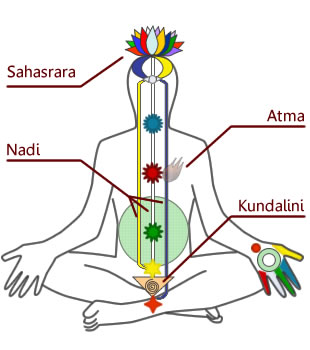
In yogic philosophy, kundalini is an energy source that, when aligned with all seven chakras, leads to a shift in consciousness wherein one reaches a level of enlightenment.  It is described as a sleeping serpent coiled at the base of the spine (kundalini literally meaning "she who is coiled") which is awakened by breathing practices (meditation).
 
Several yogis and yoginis have claimed to have awakened kundalini energy and describe the sensation as a surge of power coming from the base of the spine (root chakra) and shooting upwards through the remaining 6 chakras to 'explode' out of one's crown chakra.  When this happens, one's shakti energy (that of the subtle body) is combined with one's shiva energy (that of the cosmos) in a blessed union resulting in a level of enlightenment or clear-sight not otherwise experienced.
 
Yes, it sounds kind-of esoteric and not the kind-of thing normally experienced in a run-of-the-mill yoga class.  That's because it is and, usually, it's not.  Individuals practice meditation for years to achieve such a state and even then it is fleeting (but then again, what in life isn't?)

However, that doesn't mean that we can't strive for it and practice the techniques that can help us try to achieve it.  Because meditation, however it is done. is ALWAYS a good thing.
 

Tuesday, April 12, 2016

J is for Judgement

 
 As always, a huge shout out to Ninja Minion Master Captain Alex and his army of ninja minions! 


My Theme: Yoga.  For those of you who don't know, I've been working on obtaining my yoga teacher's certification for the past year and am just a little over a month from graduating with my RYT200.  As such, I figure there's no better way to spend this month than teaching you folks some of what I've learned.
 In a large way, yoga and all the things that come with it (meditation, reiki, etc) are paths to seeking vidya which is a sanskrit word meaning "clear sight".  It's about trying to see reality as is it really is, without all the millions of ways in which our individual perspective misconstrues things.  At the top of that list, of course, is judgement.

We judge everything.  Other people, the world in general, ourselves.  Especially ourselves.  We see ourselves as lacking, as less than, as not enough of- in almost every way.  And we torture ourselves with an endless sea of judgements (or, at least, I do.)

Yoga is about, among other things, trying to see past that to the real truth: the fact that you, with all of your perceived flaws and failures- are exactly what you are meant to be.  Which is perfect.

It's about celaring our minds of that judgement so that we can see the truth.  Which is that we are already held.  Already healed.  And already whole- exactly as we are.

Monday, April 11, 2016

I is for Ishvarapranidhana

 
 As always, a huge shout out to Ninja Minion Master Captain Alex and his army of ninja minions! 


My Theme: Yoga.  For those of you who don't know, I've been working on obtaining my yoga teacher's certification for the past year and am just a little over a month from graduating with my RYT200.  As such, I figure there's no better way to spend this month than teaching you folks some of what I've learned.
 Ishvarapranidhana is a Sanskrit word meaning (roughly) to lay one's practice at the feet of god.  It is one of the five Niyamas (ethical instructions) of the eight-limbed path (more on that later in the alphabet!) Despite it's difficult pronunciation it has a rather practical meaning.
Every yoga class is different.  No matter how many times you go, no matter how much you practice, no matter how bad-ass your downward-facing dog pose may be there is always a limit to what you can do.  Some of this is pure genetics- not all humans are shaped the same.  (And no, I don't mean some are short or tall or fat or thin I mean people have differently shaped joints, bones and other unchangeable factors that make them quite different from the next person.)  Some of it is incidental (injuries, aging and the like that prevent the body from moving the way it used to).  Some of it is simple limitations of the day in which you are practicing (i.e. you might not have the best yoga class ever when your life is exploding and there's nothing you can do about it).

All of it means that on any given day, for any given number of reasons you will reach a point in practice where you can't go any further- that's the deepest expression of the pose, that's as far as your body can bend that way, that's as good as you can focus with all those life altering worries plaguing you.  Ishvarapranidhana is coming to that place and accepting it- this is all I can do.  It's a mindful awareness that you have done everything you can do and it does not involve judgement, disappointment or negativity of any kind- because it's not a bad thing.  It's simply what is.

On the mat, it comes when you allow yourself to fall back into child's pose or take an extra few breaths or finally lie down in savasana.  Off the mat (in real life) it comes when we are smart enough to realize that we're hitting our heads against the proverbial brick wall and finally try another tactic.  Or when we allow the experience to be what it authentically is without getting tied up in what we want it to be or had planned for.  Or when we let go of the parts our life that have ended and make space for new parts to begin.  Or when we look at ourselves in the mirror with all of our mistakes, less-thans and limitations and love ourselves exactly as we are because we realize that we are exactly what, where and how we're meant to be.

This is one of the most fundamentally important concepts of yoga to practice in everyday life.  And what your body can and can't do is only the tiniest portion of it.
Come back tomorrow for J!

Sunday, April 10, 2016

Perfect Timing

It's been happening to me a lot lately- the universe coming in and telling me (in unequivocal terms): "I've got this."

Why did I change my entire life around, leave a decade-long relationship and finally take that huge plunge of moving and starting over NOW?  Because I had exactly what I needed in place to be able to do that: the support system, the courage and the fierce self love (all three of which were lacking in the past).

Why did I get this apartment- the one I'm sitting in right now as I type this- at the exact right time to allow me to get off of my friend's couch after only a couple of weeks?  Once again, exactly what I needed- exactly right time.

And why this week, when my current employer threw an unacceptable demand my way did I find myself lining up enough yoga classes to allow me to quit?  Once again- perfect timing.

I've been seeing it everywhere I look lately.  In the people I find myself constantly surrounded by who are constantly saying exactly what I need to hear.  In the course of each and every day as I'm reminded of lessons I desperately need to learn.  In the opportunities that crop up at exactly the precise moment I need them.  The universe has got me, big time.  I have everything I need, exactly when and how I need it.

And I think, and this is the lesson here: I always have.  I just never noticed before.

Saturday, April 9, 2016

H is for Health

 
 As always, a huge shout out to Ninja Minion Master Captain Alex and his army of ninja minions!
My Theme: Yoga.  For those of you who don't know, I've been working on obtaining my yoga teacher's certification for the past year and am just a little over a month from graduating with my RYT200.  As such, I figure there's no better way to spend this month than teaching you folks some of what I've learned.
Probably the single greatest reason yoga has caught on like wildfire over here in the U.S. is its long list of amazing health benefits (though, as I've mentioned and will continue to harp on that is but a tiny percentage of the overall impact).
 
A partial list of the ways in which yoga improves physical health includes:
-Improves flexibility
-Increases muscle strength
-Strengthens spine and improves posture
-Lubricates joints and prevents cartilage breakdown 
-Strengthens bones (because your body is bearing it's own weight)
-Increases blood flow and blood oxygenation
-Drains lymph thereby improving the health of your lymphatic system (making you less susceptible to illness.  This is one of the major reasons yoga is so beneficial for cancer patients) 
-Lowers blood pressure
-Lowers cortisol thereby reducing stress, regulating adrenal glands, preventing osteoporosis and making you happy  (cortisol does a lot of bad stuff throughout our entire body)
-Increases serotonin thereby improving sleep, regulating appetite and, again, making you happy (serotonin does a lot of good stuff throughout our entire body) 
-Lowers blood sugar (great for diabetics like me)
-Lowers cholesterol 
-Improves respiration (people who practice yoga tend to take longer, deeper breaths in general which gives their entire body more oxygen) 
-Prevents digestive problems like IBS and the like (literally massages the organs from the inside thereby improving mobility of wastes out of the body)
-Alleviates pain. Period.  (You name it- injury, illness, autoimmune disorder- there's not a type of chronic pain in existence that isn't improved by yoga)
-Makes your fascia super healthy (as I spoke about on Thursday) 
-And so on, and so on, and so on...
They're coming out with new studies literally every single day on other ways in which yoga improves health so the list is only going to grow.  Scientists are sort-of losing their minds over how effective it is (while folks who have been studying the progression of yoga over the past several millennia are going "duh, why do think people have been doing it for 7,000 years?" ^_^)
Have a happy Sunday, all!  And come back Monday for I!

Friday, April 8, 2016

G is for Gita

 
 As always, a huge shout out to Ninja Minion Master Captain Alex and his army of ninja minions! 

My Theme: Yoga.  For those of you who don't know, I've been working on obtaining my yoga teacher's certification for the past year and am just a little over a month from graduating with my RYT200.  As such, I figure there's no better way to spend this month than teaching you folks some of what I've learned.
Gita is a Sanskrit word meaning "song" and is colloquially used to refer to the Bhagavad Gita which translates as "song of the lord".  It is an epic poem written somewhere in the rage of 500 to 200BC.  It tells the story of Prince Arjuna talking to the lord Krishna after a great battle in which Krisha educates the young prince on the meaning of life and how he can best live it.  As such it serves as a philosophical guideline on many of the yogic ideals and describes a spiritual lifestyle (kind-of a blue print for living).
 
It is one of several ancient texts which comprise what we know of the origins of yoga and the basis for the teachings one receives in yogic study.  Other titles in this category include the Rig-Veda, Upanishads, yoga sutras and Hatha Pradipika.
As yoga was developed over thousands of years these texts span several thousand years of cultural and spiritual development within India and most of the major religions there (Hinduism, Buddhism, Jainism and several smaller sects) derived from them.  As the various religious traditions branched off parts of these various teachings were emphasized and focused on while others were forgotten. 
As much as some sects may see this particular text as the authority on some topics most scholars see it as part of the category of texts I mentioned earlier that lay the ground work for the more clear steps outlined in later writings (which we will discuss in later letters).
Head on back tomorrow for the letter H!