*As always, WARNING: THIS REVIEW CONTAINS SPOILERS.
I'm not sure what it is about the mystique of circuses. Maybe it's one of those things that is so deeply engraved in the landscape of our popular culture that we can't separate the stories and images from memory. Whatever the cause, this book was familiar to me. The setting, the characters, the scenes- all held some nostalgia even in the midst of some really horrifying events. Too many movies set in the great depression, maybe. Too many cultural references.
It's strange, of course, to have nostalgia for a time you've only studied in American history, for images you've only seen in movies. But perhaps that's why I'm nostalgic- if I'd encountered any of these things in real life they probably would have been horrifying (not to mention that I'd be old enough not to remember having encountered any of it, anyway). Rough men living day by day in harsh times, drunks slobbering and leering over scantily clad women, disabled and malformed people being stared at by frightened children, animals being beaten and tortured in horrific conditions. None of these are happy things. And yet there's that strange nostalgia- I have seen these things before.
The reason why is because Gruen does such a fantastic job of describing it. The front cover includes a quote describing the book as "sensual" but that fails to cover it. It's visceral. The sounds, smells and physical sensations are described so exactly you feel it in your gut. This book does a better job of that than anything I've read in a long time.
Which isn't to say that the characters aren't memorable on their own- because they certainly are. But they're made far more real and alive because of the ways in which they react to this environment they're in. Hell, we spend so much time inside Jacob's own body we damned near feel like we are him. And that's a pretty impressive feat.
The plot was, in some ways, the most disappointing element of the whole story. I'm not sure why, exactly, but boy meets girl just doesn't do it for me anymore. Part of me wanted Marlena to end up being a bitch so Jacob could run off with Walter and the two of them could get into shenanigans of their own. But alas, that's not what makes the big bucks and subsequently not where this book ended up. But at least Rosie got her well deserved revenge in the end- one that I did not at all see coming from the prologue. And in the very end, I suppose an old man running off to join the circus isn't a bad note, either.
Overall, very worth the read. And I'm intrigued enough to see what else Sara Gruen has got up her sleeve.
Showing posts with label Reading Challenge 2015. Show all posts
Sunday, November 15, 2015
Saturday, September 12, 2015
The Quiet Days or The Power of a Good Book
It's a quiet sort-of day, the kind built for blankets and books but so rarely spent that way. Reality demands action: coffee and traffic and e-mailed responses. Reality doesn't give a damn how wistful you are or just how much the sky reminds you of a foggy moor or a deserted ruin. Reality just wants you to function like a responsible adult- that term that declares the death of all childhood wonder.
But today, just by virtue of the fact that reality can take tiny breaks during the weekend, there is quiet. And there are blankets. And books. And a small, cinnamon-colored dog curled up on said blankets. And a candle which smells of lavender and whose small, constant flame can take your mind to much darker, more dangerous places if you let it wander.
Nipping at the corners of thought are the irksome chores that never really get done for long enough to be called "finished". Garbage to take out, showers to scrub, the general pick-up of endless items moved out place and needing to be restored to order. But the words are more powerful and pull you into that soft lullaby where memory and fantasy dilute the vision of sharp, uncaring reality.
You float away in it, wrapped in the comfort of paper pages under finger and firm canvas bound cardboard in hand. You follow the long, meandering path of crafted thoughts and deeply felt imaginings. You let the hazy warmth of the candle cocoon you inside the small room- away from details and tasks and effort. And you thank god for the quiet.
Sunday, July 19, 2015
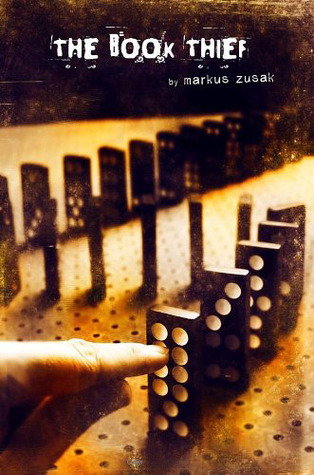
Book Review: The Book Thief by Markus Zusak
It's not just the characters that permanently lodge themselves in your heart, it's not just the moments that stick to your soul- it's the language. The book is about the power of words and that power is demonstrated throughout every beautiful page.
In a nutshell, the story is about a young girl named Liesel Meminger growing up in Nazi Germany and it's as devastatingly sad as you might imagine it to be given that setting. Without spoiling anything let me just assure you that this book will certainly rip your heart out. I can't really say I had any idea of how bad it was for German civilians before reading this book. After countless narratives and films about the holocaust I somehow imagined the entirety of Germany as a country of Nazis and neglected that conditions for civilians during that time, especially those sympathetic to Jews, was almost as bad in terms of the fear, hunger and lack of freedom.
But what really struck me about the story, and what makes it a favorite to so many, isn't the brutality or the horror of that time- it's the beauty that existed within the thick of it. The breathtaking capacity of human compassion, the depth of love, and that indefinable human spirit that makes the narrator so attracted to these creatures he is charged with unburdening.
Death makes a fascinating narrator and as a writer reading this book I was completely and totally drawn in by the tools that Zusak uses to draft the story. The translations: "A Translation of Rosa Hubermann's Announcement- 'What are you assholes looking at?'", the definitions: "A definition not found in the dictionary- Not leaving: an act of trust and love, often deciphered by children" and the short, stand-out moments he emphasizes: "A guided tour of suffering- To your left, perhaps your right, perhaps even straight ahead, you find a small black room. In it sits a Jew. He is scum. He is starving. He is afraid. Please- try not to look away." All these moments cut from the tapestry to pull you further in.
As a narrative device it keeps you on your toes- you can't fall into any reading patterns here, the writing prevents it. And if that's not enough there's always the occasional books within a book as with The Standover Man (with the simple drawings overlain on a white-washed page of Mein Kampf with the words bleeding through- which made me cry so freaking hard) and The Word Shaker (laid out as an ageless fable interspersed with cartoons). At times it feels more like a collection of treasured objects than a book.
It's also interesting how the timeline is death's- not chronology's. As he says at the beginning: "I would watch the places where we intersect, and marvel at what the girl saw and how she survived. That is the best I can do- watch it fall into line with everything else I spectated during that time." There are two standout moments in the beginning that don't occur until much later on in the story which serve the purpose of introducing the style more than anything else- letting you know from the beginning that this is Death's ship and you're just along for the ride. There are glimpses of what's going on outside of Liesel's world, reminding you that this was both the holocaust and war at the same time as it was childhood for the main character.
There were some jumps I never quite got over- letting us know that one of the greatest characters in the book was doomed to die about a hundred pages before he did, and then reminding us in fragile moments that that was coming. That was rough, and it didn't make that death any easier to handle when it did finally come. But for the most part it served the purpose- it drew me in, over and over again and kept me wanting to read. The power of words: it's a theme.
In the end though, what will stick with me the most are the characters. I collect characters like memories- they stick out in the timeline of my life and I remember them fondly as if they were witnesses to it. And these characters are so devastatingly dear to me that I will house them in my heart forever. Max with his hair like feathers and white-washed pages of Mein Kampf teaching our Liesel what words mean. Rosa with her unforgettable terms of endearment and cardboard body, forever slumped over her husband's beloved accordion as she snores. Rudy with his Jesse Owens dreams and talent for theft demonstrating what true friendship (and an endless yearning to be kissed) means. Hans with his silver eyes, pallet of paints and priceless accordion proving that love is the strongest emotion of all. And of course Liesel- the girl who's desire for knowledge was nursed and nurtured by this cast of characters, allowing her to blossom into an amazing story teller. All of them- and all of those beautiful moments with them- will stay with me for as long as I have memory and I will love them.
This book was amazing. One of my favorites. And I can't be more grateful to have read it.
Saturday, May 16, 2015
Book Review: Rebecca by Daphne Du Maurier
I had such incredibly
high hopes for this book, which I suppose was a bad idea since it set me
up perfectly to be so disappointed. The first chapter is an exemplary
education in the meaning of the word atmospheric and sets the stage for a
story much bigger than this ended up being. But, because the writing
itself is so skillfully done it's important to separate that from the
plot, so let's do that.
The quality of the writing rivals some of the best authors I've ever read. Du Maurier is so adept at the nuances of stage-setting that it's possible for the reader themselves to start having dreams about Manderley. From the descriptions of the house to the servants to the ever tangible ghost of the title character it's impossible not to get chills sometimes when reading these sentences. If you wanted to learn how to build a setting using poetic prose you could do a heck of a lot worse. It almost has a "Fall of the House of Usher" feel to it in how large the house itself looms.
But perhaps that's part of the downfall of the story- the house eclipses the characters themselves. I believe, for example, that one is supposed to like or at least root for Maxim. I hated him. HATED him. I couldn't find one redeeming characteristic the whole damned book. And the narrator herself is so wimpy and wilting that's it's easy to not really care what happens to her- and you can't have genuine fear if you don't care what happens to the characters.
I tried to remind myself that it's a different time period- women didn't have a whole heck of a lot of options back then. But I often found myself thinking that she would have been much better off if she had stuck with Mrs. Van Hopper- who, coincidentally, was way more entertaining than either of the main characters.
It didn't help that once the narrator went to Manderley nothing happened for the first 200 pages that she was there. I get that thrillers are supposed to have a slow build but this is ridiculous. And when things finally do start to happen the reading goes much quicker- but it's not a rewarding end.
At the finish I find myself glad to have read this book for the writing far more than for the story. I've heard that the movie is actually superior simply the genre allows for the slow build without the drag you feel in reading and that the charters are larger due to being well-acted. I haven't seen the movie but I'm planning to, and given everything I've heard about it I wouldn't be surprised if it's one of a very small number of cases where the film outranks the book.
The quality of the writing rivals some of the best authors I've ever read. Du Maurier is so adept at the nuances of stage-setting that it's possible for the reader themselves to start having dreams about Manderley. From the descriptions of the house to the servants to the ever tangible ghost of the title character it's impossible not to get chills sometimes when reading these sentences. If you wanted to learn how to build a setting using poetic prose you could do a heck of a lot worse. It almost has a "Fall of the House of Usher" feel to it in how large the house itself looms.
But perhaps that's part of the downfall of the story- the house eclipses the characters themselves. I believe, for example, that one is supposed to like or at least root for Maxim. I hated him. HATED him. I couldn't find one redeeming characteristic the whole damned book. And the narrator herself is so wimpy and wilting that's it's easy to not really care what happens to her- and you can't have genuine fear if you don't care what happens to the characters.
I tried to remind myself that it's a different time period- women didn't have a whole heck of a lot of options back then. But I often found myself thinking that she would have been much better off if she had stuck with Mrs. Van Hopper- who, coincidentally, was way more entertaining than either of the main characters.
It didn't help that once the narrator went to Manderley nothing happened for the first 200 pages that she was there. I get that thrillers are supposed to have a slow build but this is ridiculous. And when things finally do start to happen the reading goes much quicker- but it's not a rewarding end.
At the finish I find myself glad to have read this book for the writing far more than for the story. I've heard that the movie is actually superior simply the genre allows for the slow build without the drag you feel in reading and that the charters are larger due to being well-acted. I haven't seen the movie but I'm planning to, and given everything I've heard about it I wouldn't be surprised if it's one of a very small number of cases where the film outranks the book.
Subscribe to:
Posts (Atom)